Our goals at WATL are to continuously improve the competitive experience, both in leagues and tournaments alike. One of the biggest struggles with committing to recreation these days, is the justification to commit time and resources to it. Axe & Knife throwing are definitely not exception.
With the initiative to utilize the 2026 National tournaments as a testing ground (selected due to National hosts being among the most experienced tournament runners), each National tournament will implement the following format*.
*As it will be in development through 2026, the system below is subject to change.
Summary
For the Hatchet, Big Axe, and Knife disciplines only*, the structure at 2026’s Nationals Tournaments will consist of three stages. In stage 1 and 2, ALL competitors will participate in the both of the first two stages. The purpose of this is to improve the competitive experience, as well as increase competitor interaction, engagement and value for the entry, travel, and accommodations costs associated with attendance.
This updated format is to improve the competitive experience overall, by increasing the amount of gameplay in a single tournament, thereby not only making each tournament more lucrative for the competitor, but ideally also driving increased tournament attendance. With a directive to see each tournament more successful than the last, the WATL Tournament Committee carefully collaborated this 2026 test format to increase competitor interaction, engagement and value for the entry, travel, and accommodations costs associated with attendance.
*Hatchet Duals and Knife Duals tournament structures will remain unchanged from the standard, for all tiers of WATL/WKTL tournaments in 2026.
Nationals Tournament Structure
Stage 1: Seeding (Score)
- All competitors participate in Stage 1, which is a round robin-style tournament.
- Seeding for Stage 1 groups is determined either randomly or by tournament host discretion.
- Competitors will be divided into an even number of groups, with each group participating together on a single lane.
- Each competitor will play a minimum of 4 games against different opponents in their group.
- The last two throws of each game must be Killshot attempts.
Wins and Losses do not matter in this stage. Instead, each competitor’s performance in Stage 1 is evaluated based on their standard throw average (the average score of non-Killshot throws), with a bonus for hit Killshots.
Full formula below:
- Stage 1 Standard Throw Average (STA) = average score of all non-Killshot throws in Stage 1
- Stage 1 Seeding Score
- = (Stage 1 Standard Throw Average × 10) + (2 × ( (1 × # of 7s hit + 2 × # of 8s hit) ÷ Killshot attempts ))
- For Killshot scoring, each 7 counts as 1 point and each 8 counts as 2 points.
The final seeding scores per competitor will determine seeding for Stage 2.
Stage 2: Knockout (Wins/Losses)
- All competitors will participate in Stage 2, another round robin-style tournament.
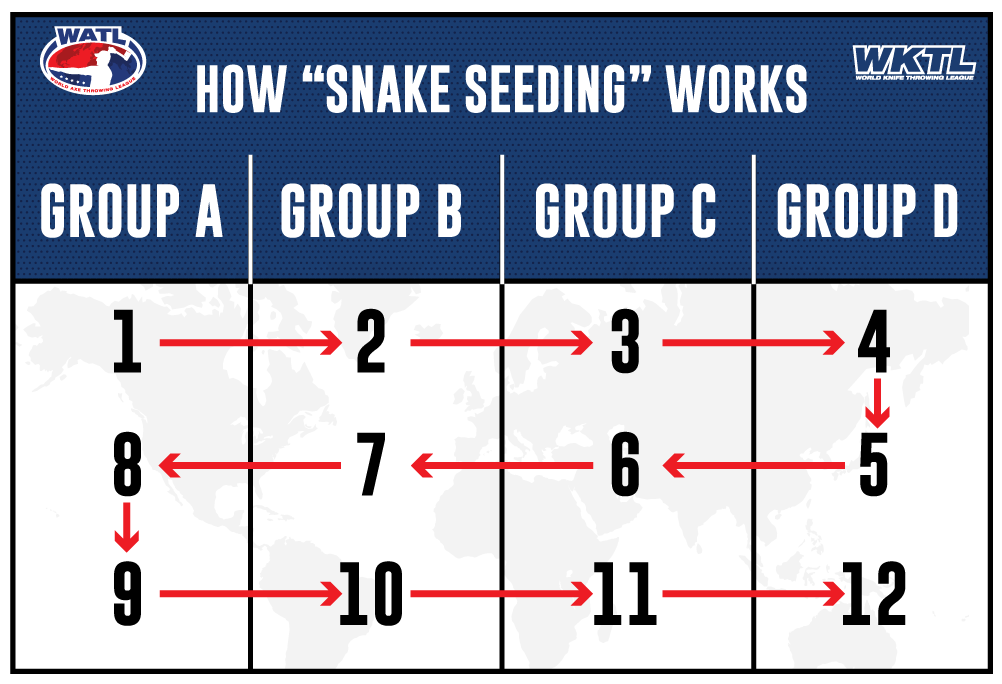
- Seeding for Stage 2 groups is determined by the results of Stage 1 seeding scores. The competitors from Stage 1 will then be snake seeded* into Stage 2 groups.
- Competitors will be divided into an even number of groups, with each group participating together on a single lane.
- Each competitor will play a minimum of 8 games against different opponents in their group.
- Stage 2 games follow standard gameplay rules for each discipline.
- Ties are broken based on the Stage 1 seeding score
The top competitor (based on the highest number of wins) from each group will advance to Stage 3.
*An example of snake seeding below. Please note, assignment is based on number of groups and participants, which will change per tournament.
Stage 3: Finals (Double Elimination)
- Only the top competitors from Stage 2 will participate in Stage 3, a traditional double elimination bracket tournament, with each match being a best 2 out of 3. This follows standard WATL/WKTL rules, played to a final, single champion.
- Seeded based on Stage 2 groups (the group 1 winner earns the 1 seed, and so on)
Additional Guidelines
Hatchet Discipline
- Due to Stage 1 being focused on the individual’s performance instead of a traditional win/loss format, there is an opportunity for both Open and Am division tournaments be combined in Stage 1( Stage 1 only). This is to be determined depending on a National’s Hatchet registration numbers, among other factors and is not a guarantee.
Judging
- All National tournaments require at least one WATL Certified Head Judge.
- Stage 1 competitors who are not actively competing will alternate judging within their groups.
- Each Judge officiating a lane during Stages 2 and 3 must be at minimum a Tournament-level WATL Certified Judge.
Competitor Expectations
- Stage 1 & 2 – Competitors are expected to remain at their assigned lane until all group matches are complete.
- Stage 3 – Competitors will have no more than 5 minutes to get to a lane once called for a match.
App Scoring
- Stage 1 (Seeding – Total Points)
- Each group will be set up in the app as a separate unsanctioned league following current gameplay rules for each discipline, with mandatory kills on the last two throws.
- Stage 2 (Knockout – Wins/Losses)
- Each group will be set up in the app as a separate unsanctioned league following current gameplay rules for each discipline.
- Stage 3 (Double Elimination)
- Set up as a sanctioned tournament in the app using current gameplay rules, as a best 2 of 3, double elimination bracket.
Looking Ahead
We’re excited to test this updated tournament structure in 2026 and see how it enhances the competitive experience for all participants.
More gameplay, more interaction, and more opportunities to showcase skills make each National tournament a better value and a more engaging event.
Your feedback will help shape this system, so be sure to complete your tournament feedback forms whenever you attend a tournament.
We can’t wait to see everyone in action on the lanes this year!
Get Exclusive Offers & Stay Up-To-Date
Sign-up today and never miss an update in the exciting world of axe throwing.