How Axe Throwing Works
Axe throwing is a sport in which players or teams face off in a lane, and throw an axes at their own target. Points are scored based on where in the target the axe sticks. The player with the highest total wins the game. After 10 throws, the highest score wins. If tied after 10 throws, a sudden death Killshot round decides the winner. The sport has three disciplines: Hatchet, Big Axe, and Hatchet Duals (teams of two).
10
Throws per Game
12 ft
Hatchet Fault Line
1–8
Points per Throw
What’s New in 2026
- Updated outer bullseye and 5-ring positions — new measurements for outer scoring zones
- Outer Killshots now score 7 pts (separate from inner Killshot at 8 pts) in Hatchet discipline
- No new stencil required — 2024 stencil + Perfect 6 works for 2026 targets
- Clarified Killshot closing rules and additional Killshot awards on drops
- Division change request process formalized with new submission form
Head Judge Authority: Head Judges interpret the rules in the interest of the community and of fair play. They may, at their discretion, alter or overrule the following rules if required for fairness. Concerns about officiating and head judge authority should be directed to the commissioner of WATL by emailing [email protected]
A. Specifications
1. Axe Regulations
| Spec | Maximum |
|---|---|
| Weight | 3 lbs / 1.36 kg |
| Length | 19 in / 48.26 cm (from top of eye) |
| Bit | 4 in / 10.16 cm (toe to heel) |
- Axes may only have one sharp bit. No sharpened bits, spikes, or blades on the poll.
- Axe heads must be held securely. Heads easily removed (clamped, screwed, pinned) are not legal unless approved by WATL.
- Illegal Axes: Any axe infringing on patents/trademarks, or those manufactured by suppliers
operating in conflict with WATL standards and policies.
- Specifically: Warriors, Hacha Manufacturing, Mirror Edge, and Urban Edge.
- Use of illegal axes may result in loss of points, position, and/or prize money.
2. Judging
- Competitors and spectators will not bully, harass, intimidate, or influence a judge. Violations are subject to a Code of Conduct violation.
- Certified Judge
Requirements:
- 1 judge per 16 competitors at leagues/regional/local tournaments
- 1 judge per lane at national tournaments
- Must be actively judging (not competing) to count during for sanctioned tournament minimums
- Judges may compete but never score their own games.
- Judges must not be impaired while scoring. Impaired judges will be removed immediately.
- Judges should avoid conflicts of interest. Conflicts must be disclosed. Competitors can request a different judge.
- Incorrect applications of rules where bias may be present could lead to revocation of certification.
- Certified Judges may be pulled from scoring at any time by any event or WATL authority.
- Suspected violations of the code of conduct or these rules should be reported to a head judge immediately.
- Gross misconduct must be reported to: [email protected]
3. Lanes
- Each throwing area is a lane containing 2 targets.
- Fences or walls block the area for safety.
- Only competitors, the lane judge, and Head Judges are permitted inside the lane during a match.
4. Target Specifications
Targets must use an official WATL stencil. Placement allowance: ½ in. Lines: black marker, 20mm thick, with a ⅛ in allowance for bleed and marker variability.
- Targets at all sanctioned leagues and events must adhere to the measurements specified in this section.
- Variances in scoring zone locations should fall within ¾ in of all corresponding targets within the lane.
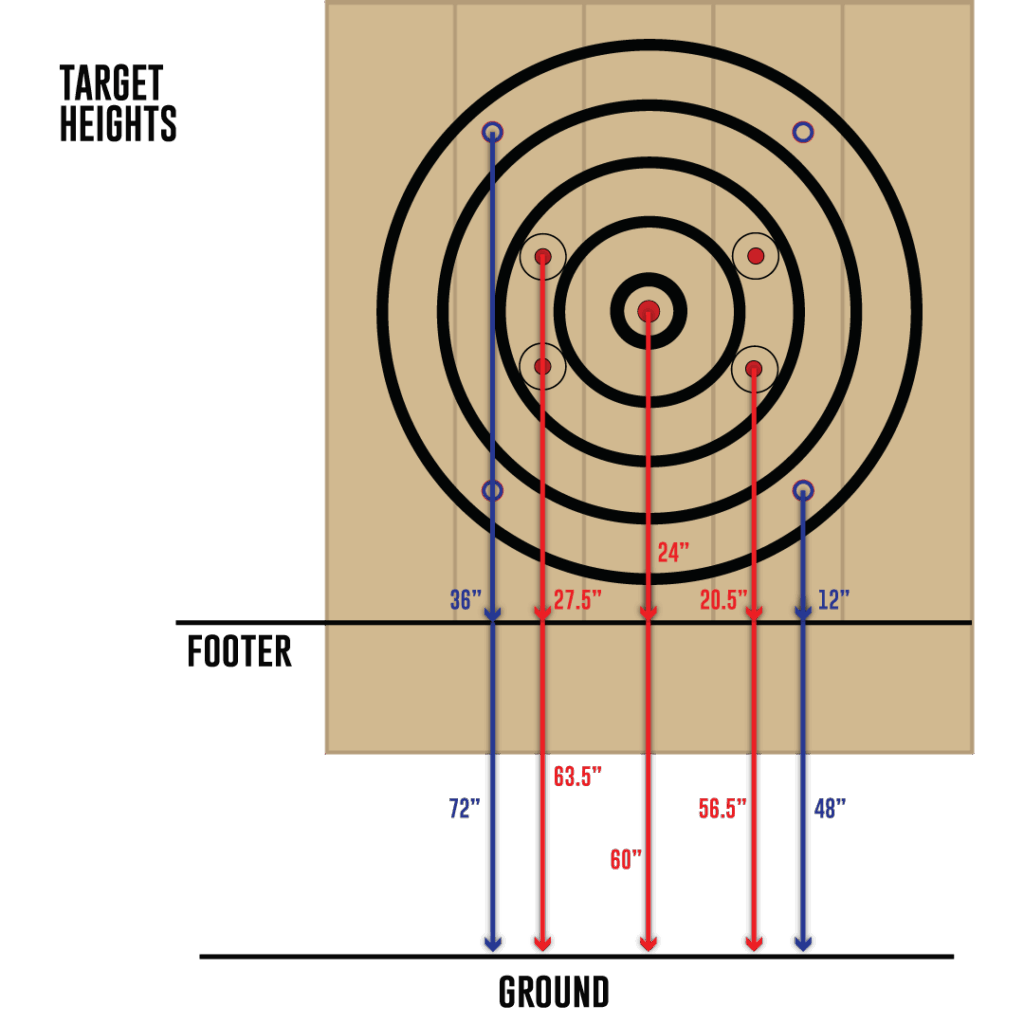
- The target’s center is 60 in from the ground, positioned at the halfway point of the middle vertical board.
- A black marker will be used to draw the target lines.
- The middle bullseye is 1.5 in diameter, centered in the target, outlined with a black ballpoint pen, and colored in red.
- In all National tournaments, the inner edge of the center 5 ring must also be outlined with a red ballpoint pen, which marks the outer edge of that scoring zone. This may also be done on any other competition boards.
- Pen lines will be drawn with the use of a centering tool such as the official WATL Perfect 6.
- The 4 outer bullseyes and 5 rings are centered within the 3 ring. The outer 5 rings are 3.5 in diameter, and the outer bullseyes are 1.5 in diameter, centered within each outer 5 ring.
- The outer 5 rings and outer bullseyes must be drawn with a black ballpoint pen, and either the outer 5 or the outer bullseyes must be colored in red.
- Inner Killshots must be outlined with a red ballpoint pen. Outer Killshots may be drawn with red or black ballpoint pen. Either the inner or outer Killshots must be colored in blue.
- Lines must be complete, with no gaps that interfere with the ability to judge scoring.
- Targets should not contain extraneous markings that would impede proper scoring.
- A wood crayon, highlighter, or other marking tool may be used within the outer 5 rings and Killshots for visual purposes, as long as the pen line is still clearly identifiable.
- Projected Targets are not permitted for sanctioned leagues or tournaments.
| Element | Size | Position (from ground) |
|---|---|---|
| Target center | — | 60 in |
| Center bullseye | 1.5 in diameter, red | Center |
| Outer 5 rings | 3.5 in diameter | Lower: 56.5 in / Upper: 63.5 in |
| Outer bullseyes | 1.5 in | (centered within outer 5 rings) |
| Killshots (inner) | ¾ in, red pen, blue fill | Lower: 48 in / Upper: 72 in |
| Killshots (outer) | 1.5 in | (centered within outer Killshots) |
2026 Target Note: Use 2024 stencil. Mark outer bullseye centers, then use a WATL Perfect 6 for 5 rings and outer bullseyes.
5. Lane Specifications
Each regulation throwing area inclusive of two targets is designated as a throwing lane.
- All target boards, backboards, footer boards, header boards, mounts, walls, and associated structures of targets and lanes must be solid, secure, and not easily movable.
- Lanes should be a minimum of 12ft of clear ceiling height, a minimum of 12ft in width with the targets
evenly distributed, and a minimum of 15ft in length, to accommodate for a 12ft fault line and safe space to
throw.
- For the Big Axe discipline, lanes should to be a minimum of 20ft in length to accommodate for a 15ft fault line and safe space to throw.
B. Hatchet Discipline Gameplay
1. Targets
- Targets should be of sound quality before gameplay.
- Boards changed/flipped at the Lane Judge‘s
discretion if:
- Excessive wiggling of axe or board risks throws falling out
- Scoring zones have gaps or missing lines
- Safety hazard exists
- Competitors may request the Head Judge inspect the boards if a request for a board change is denied.
- If targets become unscorable during the match, the Lane Judge may opt to move the match to another lane. If no lane is available, boards may be swapped out before continuing play.
- If a board is changed during a game, each player may take one warm up throw before the game continues.
- Boards must be individually secured.
- Competitors may not alter targets for advantage. Competitors may tap in a loose piece of the board with the judge’s permission. Watering the boards is not considered an alteration.
2. Warm-up Throws
| Situation | Min. Throws |
|---|---|
| First game of the day | 3 (10 suggested if no pre-practice) |
| Subsequent games | 1 |
Head Judge or venue may adjust. But all throws must be equally available to all.
3. Safety & Faults
Axe Changes: If a competitor’s axe breaks or becomes unsafe to throw, the judge may call a pause in play for the competitor to obtain a replacement axe. If a competitor wishes to voluntarily change axes during competition, they have 1 minute to do so.
[Note: Injuries are rare in axe throwing, and the most common of these are minor splinters.]
Injuries: If a competitor is injured and unable to continue the match, they forfeit. The judge must pause play so the player can be assessed, and minor injuries can be treated.
Safe Areas: Competitors and Spectators must remain in designated areas at all times. No individual may crowd, surround, or otherwise interfere with a judge while scoring, measuring, or making an official ruling.
Fault Lines:
| Discipline | Distance |
|---|---|
| Hatchet & Duals | 12 ft |
| Big Axe | 15 ft |
- If a competitor touches any part of the lane, equipment, or building past the fault line once the lane is active and before all scores are called, that throw is a fault.
- A fault may be dismissed at the Lane Judge’s discretion for incidents that occur after all competitors have thrown and their axes have come to rest.
- Wheelchair: one wheel behind. Cane/device: may rest past if feet behind.
- No headphones/ANC while throwing (medical hearing devices excepted). Competitors must inform the Lane Judge if wearing earplugs or a hearing device.
- Clear and intentional unsafe throwing will result in disqualification.
- Overhead throws: blade away from competitor.
- Spectators should maintain a safe distance from all competitors.
4. Playing a Game
- Tap any zone on the target to score
- Tapping a killshot without calling it first triggers a warning
- After throw 5, you switch targets
- 2 Killshot calls available per match
- Drop = 0 pts, earns an extra Killshot call (opposite height, except throw 10). Fault = 0 pts, no bonus.
Assume you and your opponent are tied. Want to see how overtime works?
Timing & Pauses:
- The lane is open for the next throw when all competitors and the Lane Judge have returned behind the fault line, no pause has been called, and the judge has declared the lane open.
- Throwers have ten seconds from the end of their opponent’s throw to throw their axe. Time faults may only be assessed if a timer is used by the Lane Judge.
- A Lane Judge should institute a timer if they believe a competitor’s pace suggests they might exceed the allotted time. The judge must institute a timer should either competitor request it.
- If a timer is instituted, the Lane Judge must inform the competitors, and it must be used for a minimum of 3 throws or the remainder of the game.
- Stalemate: the trailing competitor throws first. If tied, the Lane Judge will flip a coin. Once prompted, the trailing competitor has 10 sec to throw or it counts as a fault.
- The Lane Judge may call a pause for any reason. Competitors may also request a pause at the judge’s discretion.
Challenges:
- A competitor may challenge any score called by the Lane Judge.
- Both competitors must return behind fault lines until the final call is made.
- If a competitor alters the position of an axe after a challenge is called, the lower value is automatically applied.
- The final call is always made by the Head Judge (or another Certified Judge selected by the Head Judge). The final call is final and binding and may not be disputed further.
- The Lane Judge must always make a call on each throw.
- Competitors may not retroactively issue challenges to completed matches.
- Spectators cannot make challenges unless they are a minor’s representative.
Sudden Death:
- Clockwise Killshot rotation. Start on any Killshot. First to score higher wins. Measuring tied misses starts from the 3rd sudden death attempt.
- If the game is still tied after 10 throws, competitors move to sudden death, where only Killshots are scorable.
- Each competitor selects which Killshot they will attempt, with the first to score higher winning the game.
- If both competitors miss on the 1st or 2nd sudden death Killshot attempt, they will rotate Killshots
clockwise from their previously attempted Killshot. On or after the 3rd sudden death Killshot attempt, if both
competitors miss on the same attempt, the Lane Judge will measure the distance from each axe’s closest scoring
area to their respective scoring zones.
- Axes that drop or stick outside the target boards (such as the header or footer) are considered unmeasurable and are not considered when measuring for the shortest distance.
- If the measurements are tied or both axes are unmeasurable, competitors will throw again, rotating Killshots clockwise.
- The competitor with the shortest measurable distance will be awarded the game.
Appeals Process:
- If a competitor believes an incorrect application of the rules is being assessed, they may appeal to the Head Judge.
- If the competitor believes the Head Judge is also not properly applying the rules, they may file an appeal to the WATL Head Judge, the Head of Officiating, or any designated WATL rules expert.
- The appeal must include: the specific rule in question, a detailed description of the incident, and any supporting evidence (video, photographs, witness statements, or other).
Minor Representatives:
- Competitors under 18 may name a representative to act on their behalf. The representative may only challenge calls on behalf of the competitor.
- Each representative must be named before the start of the sanctioned event and communicated to Certified Judges.
- The representative is expected to follow all rules of play as if they were the competitor.
Have a question about a rule? Ask WATL Directly →
5. Scoring
All scoring is by touch scoring; the scoring area of the axe that directly contacts the valid scoring zone of the target.
Scoring Area of the Axe:
- The valid scoring area includes the bit up to the front of the eye, but not past it.
- If there is no visible eye, the valid scoring area is determined by where the front of the handle meets the axe head.
- Axes containing more than one bit embedded in the target will score based on the valid, intended scoring area of the axe.
- An axe is scored based on the highest valid scoring zone that touches the valid scoring area.
- Axes cannot be moved to determine score and must be scored as they lie.
Scoring Zones of the Target:
- Point values assigned to all areas up to the outermost black ring’s outer edge and not past it.
- Scoring zones may change point value based on the discipline/divisional rule variations after being scored.
- Scoring zones boundaries extend from the outermost edge of the black ring or pen line of the higher neighbouring scoring zone, to the innermost edge of black ring or pen line of the lower neighbouring scoring zone.
- Any part of the axe’s scoring area embedded below the plane of the scoring zone’s surface does not count.
- Wood significantly shifted away from the intended scoring zone does not count.
| Zone | Points | Notes |
|---|---|---|
| 1 Ring | 1 | Hosts 4 Killshots |
| 2 Ring | 2 | |
| 3 Ring | 3 | Hosts outer 5 rings & bullseyes |
| 4 Ring | 4 | |
| 5 Ring (outer + center) | 5–6 | Outer ring = 5 pts · Red bullseye center = 6 pts |
| Outer Killshot | 7 pts | Must be called |
| Inner Killshot | 8 pts | Must be called |
Ring line scoring: Black ring lines (the drawn strokes) score the lower of the two zones they separate. For example, an axe touching the 3-ring line (but not inside the 3) scores 2, not 3. An axe touching the 1-ring line (outermost) scores 0.
Key Rules:
- Black rings = lower of two values they separate
- Outside outermost black 1 ring = 0
- Axe falls before scored = drop (0)
- Axes cannot be moved to determine score
- 2 Optional Killshots per game (call before throwing)
- Drop (except throw 10) → +1 additional Killshot
- Successfully scoring a Killshot closes both at that height
- Additional Killshot from drop → opposite height
- Killshots don’t reset at the half
C. Hatchet Divisions
Three tiers with progressively stricter closing. All use Section A & B base rules.
| Rule | Rec | Am | Pro |
|---|---|---|---|
| Level | Beginner / Casual | Intermediate | Expert |
| Closing | None — all open | Each bullseye & 5 ring closes individually | Any hit in a 5 ring closes the entire ring |
| Closed Zone Hit | N/A | Scores the ring value (closed 6 + open 5 = 5) | Scores 0 |
| Two Open Zones | N/A | Competitor chooses | Competitor chooses |
| Open + Closed | N/A | Defaults to open | Defaults to open |
| Reset | N/A | All reopen at half | All reopen at half |
Click Rec, Am, or Pro to highlight that division’s column
1. Rec Division
The Rec division is the beginner level for participants of the World Axe Throwing League.
- The Rec ruleset is the base game as highlighted in the sections above.
2. Am Division
The Am division is the intermediate level for competitors of the World Axe Throwing League.
Gameplay Changes — Closing Point Values:
- Each unique Bullseye and 5 ring close out once scored in a half.
- If an axe is embedded in the target where there are two open same-value closeable scoring zones in contact with the axe’s scoring area, the competitor can choose which closeable scoring zone counts for that throw, and closes out.
- Any closed point values (aside from Killshots) once hit a second time in a half will score according to the
ring’s value that the closed point value resides in. For example:
- Hitting a closed 6 while the 5 value is open, results in a 5.
- Hitting a closed center 5 while the center 5 value is closed, results in a 4.
- Hitting a closed outer 5 will result in a 3.
- Should the scoring area of the axe be in two valid closeable scoring zones where one is already closed, the value defaults to the open scoring zone.
- All non-Killshot values open when opponents switch sides.
3. Pro Division
The Pro division is the expert level for competitors of the World Axe Throwing League.
Gameplay Changes — Closing Point Values:
- Hitting any scoring zone within a 5 ring closes all scoring zones within that ring for the remainder of the half. Hitting inside the same 5 ring a second time in a half will result in a score of 0.
- If an axe is embedded in the target where there are two open same-value closeable scoring zones in contact with the axe’s scoring area, the competitor can choose which closeable scoring zone counts for that throw, and closes out.
- Should the scoring area of the axe be in two valid closeable scoring zones where one is already closed, the value defaults to the open scoring zone.
- All non-Killshot values open when opponents switch sides.
4. Division Changes
- Competitors can submit a request to move to any division between seasons and WATL® will review requests on a case-by-case basis.
- Any competitor who accepts a bid to the World Axe Throwing Pro Hatchet Championship will automatically be declared as Pro for the following season.
- Competitors cannot change their division if they have played 1 or more games during an active season for any reason.
- Should a division change from Am to Pro, or Pro to Am be approved, all Circuit Points, bids, invites, or entries that were related to the original division of that discipline are forfeited immediately. Should the competitor switch back to their previous designation in the future, those points/bids/etc will not be reinstated.
D. Big Axe Discipline
Big Axe follows Section A & B rules with exceptions below. Outer bullseyes and 5 rings in the 3-ring are not active.
Big Axe at a Glance
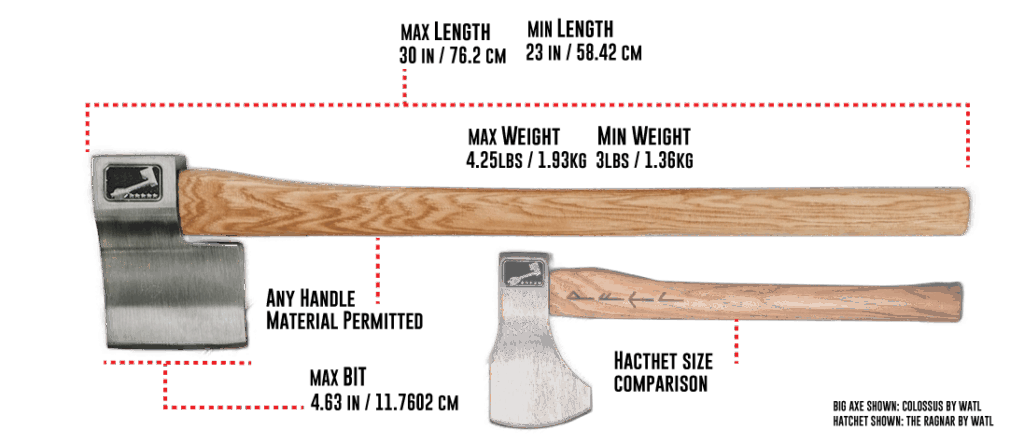
7 throws/game 15 ft fault line 3–4.25 lbs 23–30 in handle
Axe Specifications
| Spec | Requirement |
|---|---|
| Weight | 3 lbs min — 4.25 lbs max |
| Handle | 23 in min — 30 in max |
| Blade | 4⅝ in max |
Gameplay Differences
- 7 throws per game (not 10)
- Same target all game — switch between games
- Fault line: 15 ft
Scoring Differences
- 5s and bullseyes on center board only
- All Killshots = 8 pts (no 7/8 distinction — both inner and outer score 8)
- No extra Killshot for drops
- Only hit Killshots close — no height alternation until sudden death
Sudden Death
Clockwise Killshot rotation. First to score higher wins. Measuring from 3rd attempt.
E. Hatchet Duals Discipline
Hatchet Duals follows Section A & B with exceptions. Two teammates throw simultaneously. Outer bullseyes and 5 rings in the 3-ring are not active.
Hatchet Duals at a Glance
5 throws/game 2 axes/throw 12 ft fault line 2 Killshot calls
Gameplay Differences
- 5 throws per game. Each = 2 axes simultaneously.
- All 5 at same target. Switch between games.
- Must throw from approximately same distance.
Fault Rules
- Fault by either teammate = fault for both axes on that throw
- One axe hits the target before partner releases their axe = fault
Scoring Differences
- 5s/bullseyes on center board only
- Killshots = 8 pts
- 2 calls per game (separate or same throw)
- Same Killshot hit by both = 16 pts if both called
- Killshots close after both axes scored
- Axe in axe: both get embedded axe’s value
- Removing scored axe drops partner’s → lower score given
- No extra Killshot for drops
Sudden Death
- Individual clockwise rotation
- First team to outscore in single attempt wins
- From 3rd attempt: shortest measurable distance wins
Previous Rulebook: 2025 rules inactive as of 12/31/25 (except World Championship April 2026). View 2025 Rules → · Rule Change Log →
F. Code of Conduct
Standards of behavior for all competitors, spectators, judges, and persons associated with WATL-sanctioned events.
1. The WATL Pledge
The World Axe Throwing League is dedicated to the development of axe throwing through competitive play and fostering camaraderie in the community. We strive to promote competition through sportsmanship and fair play. Although competition may become intense, we expect our participants to maintain a high degree of sportsmanship up to and after the final throw.
This Code applies to competitors, coaches, judges, parents, guardians, hosts, family, friends, and spectators at all sanctioned events.
As a WATL participant, you pledge to:
- Respect the game, play fairly, and follow all rules and policies.
- Accept and respect the decisions of WATL officials.
- Demonstrate good sportsmanship before, during, and after games regardless of outcome.
- Be responsible for the sportsmanship of teammates and assist in maintaining a respectful environment for all participants.
- Be courteous to opposing competitors, teams, officials, spectators, judges, and facilitators, and treat all competitors and WATL officials with respect.
- Help to maintain and keep all equipment and conditions at the venue in good condition.
- Obey all venue rules, while respecting all equipment, common areas, playing areas, parking areas, and surrounding neighborhoods.
- Not engage in discriminatory behavior based on race, religion, creed, language, disability, gender identity, or sexual identity.
- Refrain from the use of abusive language or profanity. Including but not limited to contemptuous, discriminatory, or denigratory words, or actions concerning race, language, religion, gender identity, or sexual orientation.
- Not engage in behavior that endangers the health, safety, or well-being of any person.
- Not use alcohol unless permitted by the venue; not allow, use, or encourage illegal drugs.
- Use/wear all required equipment and uniforms.
- Accurately represent your standing within WATL when communicating with sponsors, media, and third parties. Do not make false, misleading, or exaggerated claims regarding tournament wins, rankings, titles, roles, accolades, or sponsorships.
Under no circumstances are live targets allowed. No competitor is to throw an axe at a target while any person or live object is between the competitor and the target.
2. Zero Tolerance Policy
WATL has zero tolerance for: threatening verbal or physical abuse, unsportsmanlike conduct, bullying (online and offline), and any actions detrimental to individuals or WATL’s mission.
3. Unique Misconduct
Purposeful Distractions: defined as (but not limited to) excessive celebration, taunting, abusive or threatening language, trash-talking, stepping in the lane during a throw, excessive noises, or offensive gestures.
| Offense | Competitor | Spectating Participant | Non-Participant Spectator |
|---|---|---|---|
| 1st | Zero score for that throw + warning | Zero on first throw of next game | Immediate removal from facility |
| 2nd | Forfeit of game/match | Forfeit of subsequent game/match | — |
| 3rd | Forfeit of season/tournament | Forfeit + no spectating | — |
Game Fixing & Sandbagging: If any competitor is found to fix a league game/tournament match to achieve a desired outcome then that competitor will be banned from all WATL® tournaments & leagues. Competitors may appeal the ban, one year after the offense, pending review by the Commissioner.
Deliberate Disruption: If any competitor or spectator is found to intentionally delay the flow of a league or tournament through underperformance, unreasonably frequent challenges or excessive lingering past the fault line, they may be subject to a Code of Conduct violation.
4. Sportsmanship
Participants must handle disputes constructively. WATL® has sole discretion to investigate all evidence. Protests for competitor eligibility or rule misapplications or misinterpretations are time-sensitive and must be made before the next throw. Non-competitors cannot argue or challenge Judge calls. All decisions by on-site officials must be respected.
5. Social Media
As an international, yet still growing sport, WATL recognizes the importance of social media in shaping the public perception of our sport and organization. WATL also recognizes the importance of our Council Members, sports coordinators, judges, employees, volunteers, and competitors in leading and setting the tone of social media interactions in a manner that advances the mission and goals of WATL.
This Social Media Policy applies to all WATL officials, Affiliates, Ambassadors, Council Members, Judges, employees, volunteers, and competitors, collectively referred to as “WATL Members”. This Social Media Policy applies to all social media content posted by WATL Members in their professional and personal capacity; defamatory or disparaging of WATL or other WATL Members, in relation to WATL.
WATL strives to create a positive and inclusive organization that is dedicated to helping participants reach their full potential. To further this goal, WATL strives to engage members of the community in a positive, honest, transparent, and knowledgeable dialogue about WATL through social media. WATL views social media as an important tool for communicating its successes and opportunities for community and individual development.
All WATL Members shall abide by the following guidelines when using social media:
- Be respectful and always take the high road. When disagreeing with others’ opinions, remain appropriate and polite. If you find yourself in a situation online that is becoming antagonistic, disengage entirely from the conversation. Report any behavior to WATL if the interaction violates WATL’s code of conduct.
- Do not participate in or encourage Trolling. Trolling is defined as starting quarrels, sowing discord by posting inflammatory, digressive, extraneous, or off-topic messages to competitors, and the posting of images to incite conflict within WATL and its members.
- Refrain from posts or comments that are defamatory, disparaging, slanderous, or contentious against other WATL Members.
- Encourage others to engage in constructive interactions on social media. If you are concerned about any WATL Member’s use of social media, please bring your concerns to the attention of WATL.
- Personally identifiable information such as date of birth, street address, phone number, or other sensitive information that can identify a particular individual (doxxing) should not be disclosed in any manner on official WATL social networking sites without the approval of WATL and the individual in question.
By participating in WATL-sanctioned events, attending a WATL Affiliated Venue, or engaging in any WATL social media property, you are subject to this Social Media Policy. WATL may, at its sole discretion, enforce this policy and has the authority to remove any inappropriate or offensive comments from official WATL sites. WATL may block any individual or organization from posting on any official WATL social media platform at their sole and absolute discretion.
Any WATL Member who fails to adhere to the Social Media Policy may be considered in violation of the WATL Code of Conduct and may be subject to disciplinary actions as stated in the Disciplinary Procedure section below.
6. Disciplinary Procedure
Failure to comply with the Code of Conduct may result in penalties, including possible dismissal from the event and/or being banned from attending future events. A general sequence of actions that may be applied by a WATL Certified Judge or other official:
- First offense: verbal warning.
- Second offense: most recent game points set to 0, counted as a loss.
- Third offense: suspension for the remainder of the season or tournament.
Officials are not required to follow this order. WATL reserves the right to enact disciplinary measures, or suspend competitors or spectators as necessary at its sole discretion. Other disciplinary procedures include but are not limited to:
- Suspension including ineligibility for tournament and league play
- Suspension for the current season
- Permanent suspension from all WATL activities, events, tournaments and league play
Feedback or concerns: [email protected]
7. Reporting Violations
If you are the subject of or witness to what you believe are violations of the Code of Conduct or Social Media policy, you can confidentially email [email protected] or click the button below. Contacting [email protected] guarantees your privacy, as any incoming mail exclusively goes to the inbox of the Commissioner.
Wherever possible, infractions during an event or at a WATL-affiliated venue should first be attempted to be resolved immediately at that time and place.
When reporting infractions to WATL, include as much information as possible, including screenshots where relevant, an accounting of all events being reported, and any relevant supporting video, links, etc. All emails and communications are considered confidential until noted otherwise. *Note that WATL will not get involved in interpersonal issues between individuals, only blatant violations of the noted Code of Conduct and Social Media policies.
Should an investigation be deemed warranted, the violation will be brought before the WATL Disciplinary Committee which consists of individuals and/or venue owners that have no conflict of interest in the specific situation, for the purpose of the investigation. Said Committee will direct the WATL Commissioner (or other appointed WATL Official) in the gathering of additional information if warranted, including the point of view from both parties involved where relevant.
The WATL Disciplinary Committee will then recommend a course of action to WATL related to the situation, and severity, as well as any disciplinary actions it feels are necessary. WATL may accept the recommendations from the Committee and enact them, or choose to proceed with alternative courses of action, solely at their own discretion.
Parties that reported the violation, or participated in the investigation, are not entitled by default to know the outcome of the action (other than that it has been resolved), regardless of the chosen action, nor is WATL obligated to publish the results of the investigation publicly. WATL will always work to resolve violations without the need for punitive action, with suspensions being reserved for only the most egregious of violations, or for repeated violations.
Witnessed a Code of Conduct violation? Report it Confidentially →
8. Appealing Disciplinary Actions
Any competitor that has been subject to disciplinary action may appeal the decision within 30 days, unless otherwise communicated in the decision, via a method provided in the decision issued. In the case that an action is appealed, the WATL President or CEO will review the investigation, and perform any additional due diligence that they may feel necessary.
The President/CEO will make a final decision on the appeal and may change or uphold the initial decision, at their sole discretion. This decision will be final and binding, and no further appeals will be accepted.