WATL is committed to listening closely to the community and making changes that support the spirit of the game while staying aligned with its long-term direction. These updates affect the entire ecosystem of the sport, from league operators and high-level competitors to those who just enjoy throwing casually. Because of that, the process has been rooted in ongoing discussions, how WATL can best assist affiliated venues, and what is actually happening during league nights and events where the game is played and experienced firsthand.
A huge thank you to everyone who has been part of those discussions and helped shape this process. The effort that goes into building and running leagues and events plays a big role in keeping the sport welcoming, easy to get into, and still highly competitive. We’re excited to continue building on that foundation as the sport and community continue to grow.
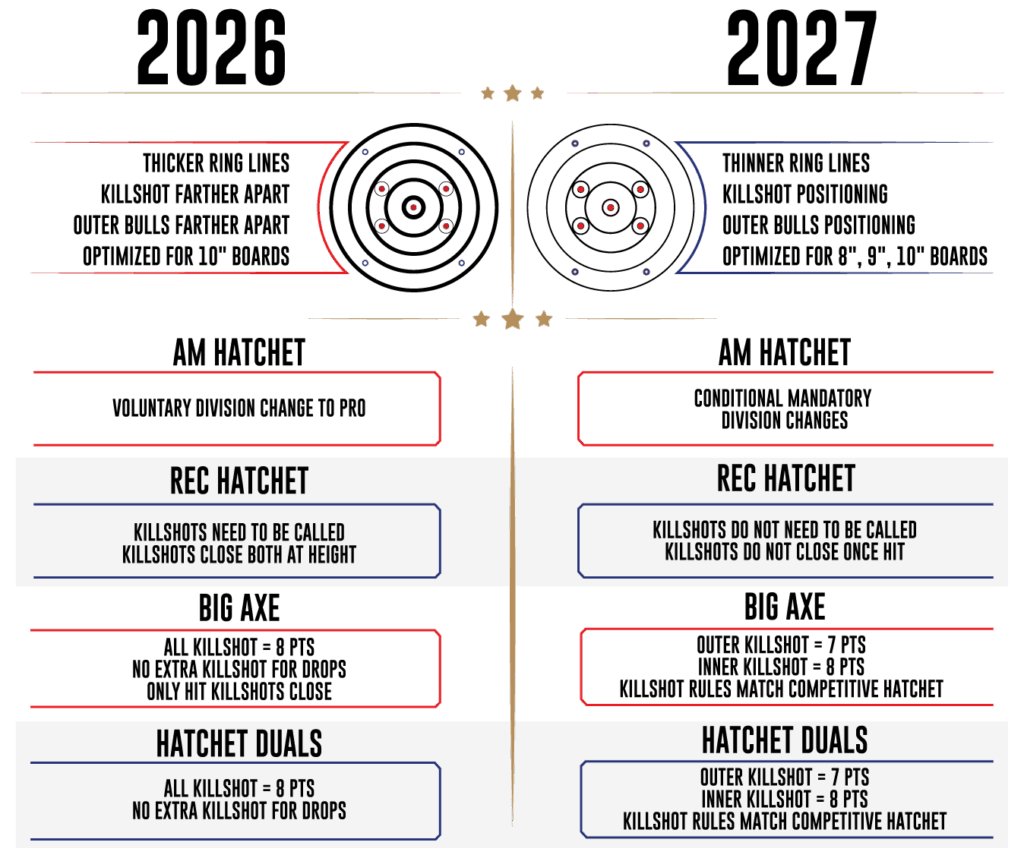
In addition to the list of gameplay updates, we want to share the intent behind next year’s ruleset adjustments. For a more detailed look and breakdown of what’s changing, read on below!
Driving Growth
The strongest priority as the world’s largest axe throwing organization is to maintain rulesets and regulations that keep the game fun and competitive.The rules and target changes for our 10th anniversary were approached with consistency and stability in mind for all WATL participants – which is why we designed these rules and target changes with the expectation that they would last years without further adjustment. Our primary objective with any rules changes is to best serve the competitive and recreational WATL communities, and the affiliates that help give them a place to come together.
We believe the following changes will help WATL achieve the goals by leveraging the recent stability in gameplay and target design, as well as the practical experience and invaluable community feedback over the past 10 years of the organization’s history.
Broadening Divisions & Simplifying Discipline Variation
In a great amount of feedback we received in 2026, the community wanted to see further variation between divisions, particularly between Am Hatchet and Pro Hatchet. To that effect, instead of approaching the issue with further differential between the rulesets, the Rules Committee and WATL leadership have concluded that the best way to accomplish that in 2027 is to make sure those who are playing at a Pro level, are moved to the Pro division instead of strictly relying on competitor preference. In addition, we have elected to move forward with minute changes to the Rec ruleset.
Rec is as easy as possible now, to encourage the smoothest and easiest-to-explain entry to the sport by removing all closing point values (Killshots!). This is more in-line with the general understanding that the unaffiliated/inexperienced public has about axe throwing rules.
Regarding Big Axe and Hatchet Duals, we have made some minor changes to Killshot scoring to unify the disciplines with the successes of Hatchet in mind.
Pro Hatchet
- No change
Am Hatchet
- No change
Rec Hatchet
- Killshots
- 2026:
- 2 Optional Killshots per game (call before throwing).
- Successfully scoring a Killshot closes both at that height
- 2027:
- Killshots do not need to be called
- Killshots do not close once hit
- 2026:
Big Axe
- Killshots
- 2026:
- All Killshots = 8 pts (no 7/8 distinction — both inner and outer score 8)
- No extra Killshot for drops
- Only hit Killshots close — no height alternation until sudden death
- 2027:
- Outer Killshot = 7 pts
- Inner Killshot = 8 pts
- 2 Optional Killshots per game (call before throwing)
- Drop (except throw 7) → +1 additional Killshot
- Scoring a Killshot closes both at that height
- Additional Killshot from drop → opposite height
- 2026:
Hatchet Duals
- Killshots
- 2026:
- Killshots = 8 pts
- No extra Killshot for drops
- Sudden Death:
- If the same number of Killshots are hit by both teams, sudden death continues clockwise unless 0 Killshots are hit.
- 2027:
- Outer Killshot = 7 pts
- Inner Killshot = 8 pts
- Drop (except throw 5) → +1 additional Killshot
- Scoring a Killshot closes both at that height
- Additional Killshot from drop → opposite height
- Sudden Death:
- If there is 1 miss and 1 hit per team on a single attempt and the score is tied, the Judge will measure the missed axes to determine a winner.
- 2026:
Protecting Divisional Skillset Representation
A major consideration when reviewing our divisional structure was ensuring that each division continues to represent the appropriate level of competition. As the sport continues to grow, we need to make sure competitors are able to develop and compete in the division that best matches their current skill level, while also preventing situations where they remain in a division after they have clearly demonstrated Pro-level performance.
Currently, movement between Am and Pro relies primarily on competitor choice, which can create situations where top-performing competitors remain in Am competition despite consistently performing at a higher level, dominating their competition. To address this, we are introducing advancement criteria based on both championship performance and sustained league results.
The goal is not to limit competition or progression, but to ensure each division continues to provide meaningful competition and opportunities for growth at every level.
Division Change Adjustments (Hatchet Only)
Am Championships Placement: Am Hatchet competitors who finish in the top 8 at the Am Hatchet Championship will be mandated to move from Am to Pro in Season 1 of the competitive year that follows the Am Hatchet Championship tournament date.
For example: WAKTC IX (4.19.2026) Top 8 finish = 2027 Season 1 Pro division change.
- Am Championships Placement
- Am Hatchet competitors who finish in the top 8 at the Am Hatchet Championship will be mandated to move from Am to Pro in Season 1 of the competitive year that follows the Am Hatchet Championship tournament date.
- For example: WAKTC IX (4.19.2026) Top 8 finish = 2027 Season 1 Pro division change.
- Am Hatchet competitors who finish in the top 8 at the Am Hatchet Championship will be mandated to move from Am to Pro in Season 1 of the competitive year that follows the Am Hatchet Championship tournament date.
- From League Ratings
- At the end of the competitive year (after Season 4), Am Hatchet competitor ratings will be calculated using their top 3 league seasons from the year (using the WATL Tournament Seeding Tool).
- These ratings will be compared against the ratings of the Pro 128 competitors who earned WAKTC Pro Hatchet bids, using only the two seasons that counted toward their qualifying bid.
- Any Am Hatchet competitor with an average rating equal to or higher than the lowest qualified Pro 128 rating will be automatically moved to the Pro Hatchet division beginning in Season 1 of the next competitive year.
- At the end of the competitive year (after Season 4), Am Hatchet competitor ratings will be calculated using their top 3 league seasons from the year (using the WATL Tournament Seeding Tool).
*Am Hatchet bids earned in the previous year will persist to the Championship that they were earned for, and the bid winner will be able to compete as an Am accordingly.
Opponent Scoring and Judge Certifications
A potential change to the judging structure and implementation of an opponent scoring model is currently being tested at the final two National tournaments this year. With a goal of reducing the burden on judges at league and tournaments, while still maintaining the integrity of the sport and our community, we will share the results and ask for feedback later this year. Please note, any changes to scoring/judging/judge certifications have not been confirmed or finalized yet.
The WATL Target
Every Dollar Counts
A potential change to the judging structure and implementation of an opponent scoring model is currently being tested at the final two National tournaments this year. With a goal of reducing the burden on judges at league and tournaments, while still maintaining the integrity of the sport and our community, we will share the results and ask for feedback later this year. Please note, any changes to scoring/judging/judge certifications have not been confirmed or finalized yet.
A huge driver when developing these adjustments to both our target design, and our rulesets was to find any way we can possibly increase savings for those who want to compete in WATL. As anyone who has engaged in the sport might be able to guess, one of the biggest things unique to our sport is building, maintaining, and changing targets.
With our changes to the Target design, venue owners, and those building targets at home will have more freedom of choice (in terms of compatible board sizes), as well as numerous cost savings including marker ink, board (by shipping weight and per unit), and labor in replacing/maintaining board stock.
Axes, competitors, and venues come in all shapes and sizes. So do boards.
Focusing on refining what we’ve developed during the first 10 years of World Axe Throwing League competition, we have conceptualized, drafted, and tested some relatively minor yet very impactful changes to the official target design. We are aiming for these changes to leverage the proven engaging, and entertaining design while fixing the existing issues. Resolving the overlap proximity issue of the outer 5/6s, saving venues valuable time and money, and providing a very nominal increase in difficulty.
The major changes and the ‘why’:
- We wanted to include the ability to draw the target comfortably on smaller boards: 7.25″, 8″, 9.25″, 10″ boards are all compatible.
- The compatibility change for smaller boards, if elected to downsize board sizes should save venues and at-home setups not only on labor (they’re lighter!), but also monetarily via price per board & shipping savings.
In order to fit and orient the target scoring zones within a reduced overall radius, we had to…
- Relocate the outer bullseyes and Killshots.
- By adjusting their height to accommodate the difference between where they’d land on a 10″, 9.25″, 8″, and even 7.25″ boards, we end up with an extremely similar layout, with a bonus of both resolving the issue of an axe being able to land in more than one five ring at once, as well as a very slight increase in difficulty due to upper bullseyes/Killshots being higher than previous, and lower bullseyes/Killshots being lower than previous.
- In relocating the major scoring zones aforementioned, we came across the issue of not only needing to address the awkward visual difference between identical-scoring point values (center 5/6 and outer 5/6s), but also to prevent any overlaps from getting worse.
To resolve past and potential future issues, we needed to…
- Reduce the thickness of each black ring.
- This was a serendipitous result, as the black rings lines, while good for visibility from a far distance, took up much real estate on the target. As an additional bonus, the existing marker shapes and nibs can be used in 2027 and beyond, as we’ve designed the lines so instead of using the marker tip’s wider edge, we used the thinner edge. Not only does that save on ink costs, it will also be twice as easy to draw bolder, blacker lines!
Target Changes
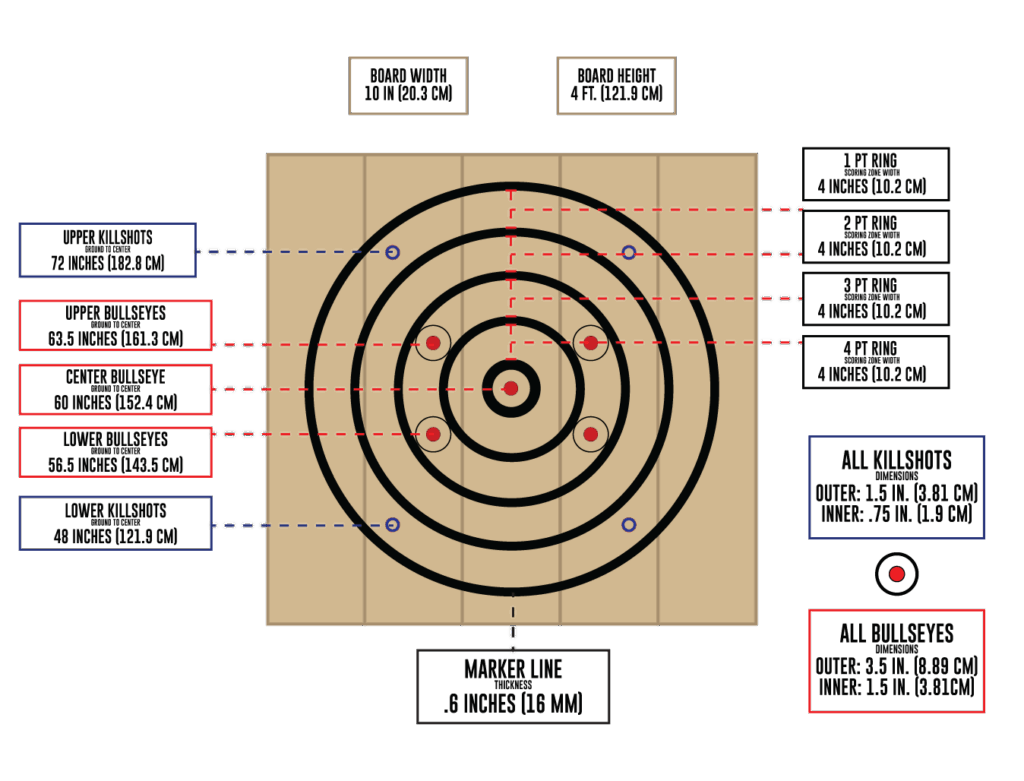
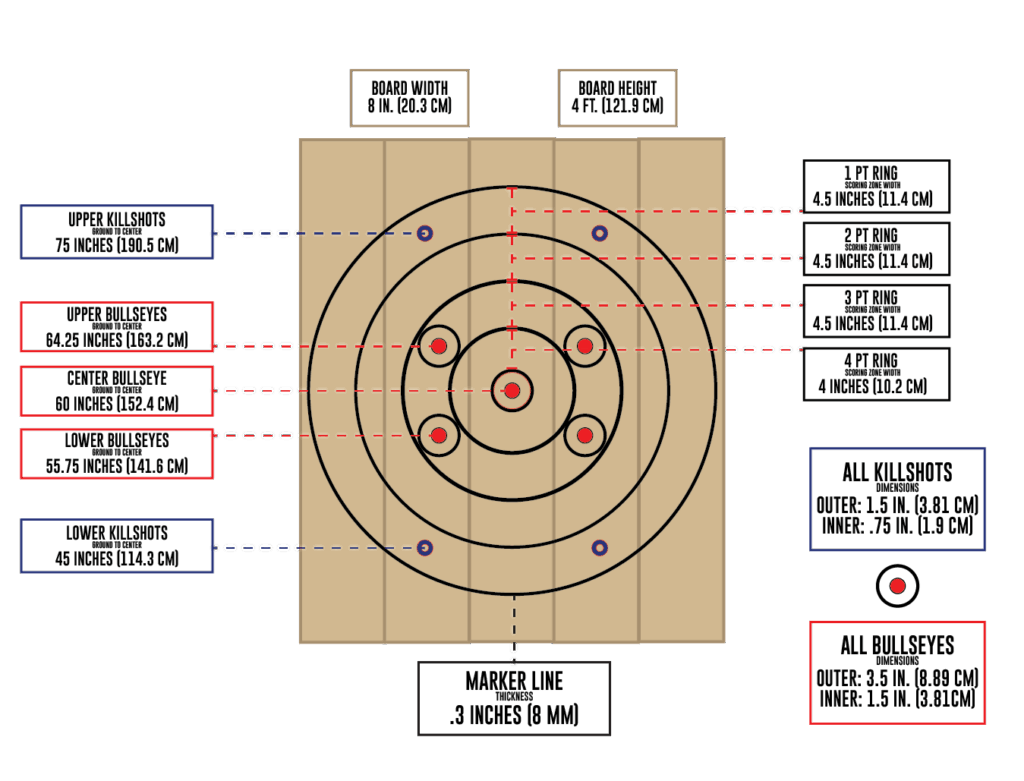
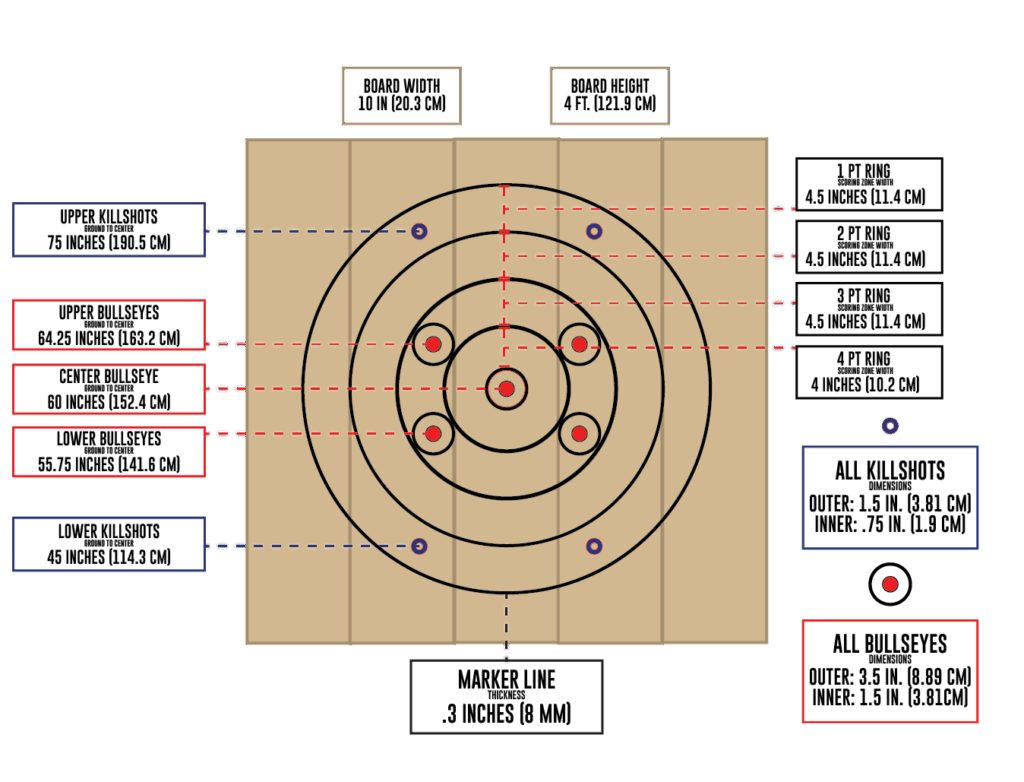
Below, are the final target design differences:
2026 (10″ – true and shop)
2027 (8″ – true and shop)
2027 (10″ – true and shop)
Black Rings
The thickness of each black ring line has been reduced by 60%. (Marker tip turned sideways)
- Black ring line width
- 2026: 0.6in/20mm
- 2027: 0.3in/8mm
Spacing Between Rings
The spacing width between select black ring lines have also been slightly adjusted.
- 1-2 ring
- 2026: 4in/10.2cm
- 2027: 4.5in/11.4cm
- 2-3 ring
- 2026: 4in/10.2cm
- 2027: 4.5in/11.4cm
- 3-4 ring
- 2026: 4in/10.2cm
- 2027: 4.5in/11.4cm
- 4-5 (center) ring
- 2026: 4in/10.2cm
- 2027: 4in/10.2cm
5 Rings
The center 5 ring is unchanged. The outer 5 rings may now optionally be outlined in black marker to match the center 5 ring instead of black pen. The outer 5 rings heights/locations have changed in accordance with the bullseye locations below.
Bullseyes
The center bullseye remains unchanged. The outer bullseye heights/locations have been adjusted to the following:
- Upper bullseye heights (to center)
- 2026: 63.5in/161.3cm (27.5in/69.9cm from footer)
- 2027: 64.25in/163.2cm (28.25in/71.8cm from footer)
- Lower bullseye heights (to center)
- 2026: 56.5in/143.5cm (20.5in/52.1cm from footer)
- 2027: 55.75in/141.6cm (19.75in/50.2cm from footer)
Killshots
The Killshot heights/locations have been adjusted to the following:
- Upper Killshot heights (to center)
- 2026: 72in/182.8cm (36in/91.4cm from footer)
- 2027: 75in/190.5cm (39in/99.1cm from footer)
- Lower Killshot heights (to center)
- 2026: 48in/121.9cm (12in/30.5cm from footer)
- 2027: 45in/114.3cm (9in/22.86cm from footer)
Putting together 10 years of gameplay and design together, we’re confident that all competitors, spectators, venue owners, and anyone else interacting with the World Axe Throwing League is going to see these changes as a very positive culmination of a decade’s worth of gameplay experience and target design.
If you’d like to share your feedback on 2027’s updates, please complete the feedback form below. The adjustments highlighted in this article are not guaranteed, nor completely unmovable. We’re looking forward to hearing from the community!
Help us celebrate WATL’s 10 year anniversary by throwing your best!